
How to cue a Pilates class people come back to
Great cueing is what turns a good workout into a class people book again. Here is a simple framework, with example cues, for studio and home instructors.
Why cueing matters more than choreography
Your class plan gets people in the door. Your cueing decides whether they come back. Good cues do four jobs at once:
- Safety. Clear setup and position cues prevent the most common mistakes before they happen.
- Confidence. When people know exactly what to do, they stop watching their neighbor and start moving.
- Results. A well-placed focus cue turns a vague movement into the exercise you actually planned.
- Retention. People rarely remember every exercise. They remember how the class made them feel.
That last point has some support in the research. In a 2025 survey of older adults in group fitness classes, summarized by ACE, participants who saw their class as caring and focused on effort and personal progress (rather than competition) reported higher motivation and stronger commitment to exercise. It is a small, perception-based study, so it shows a link rather than proof, but it matches what most experienced instructors see in their own rooms.
A simple framework: five layers for every exercise
You do not need to say all five every time. Think of them as a checklist you build up as the class learns the move.
- Set up. Position, springs and props. "Lie on your back, head on the headrest, feet on the bar in Pilates V." Get everyone ready before anyone moves.
- The action cue. What moves, in plain language. "Press the carriage out, then control it home."
- The focus cue. Where to feel it, or what stays still. "Hips stay level" or "feel the back of your legs working."
- The breath cue. One clear pattern. "Exhale to press out, inhale to return."
- The progression or regression. "Want more? Lift your heels. Need less? Keep your feet flat."
This mirrors how many strong classes are built. Maghan's own classes move from mobility and activation into upper-, lower- and full-body series, then a cool down, with every exercise layered with progressions and regressions. The layers above are how you deliver that structure out loud.
Example cues using the framework
These are illustrative examples written for this post, not quotes from Maghan. Adapt the wording to your voice and your equipment.
| Exercise | Example cue |
|---|---|
| Reformer footwork | Heels on the bar, hips heavy. Press the carriage away like you're pushing the floor long. Exhale out, inhale home. Hips stay level. Want more? Rise onto the balls of your feet. |
| Mat Hundred | Head and shoulders lift, arms long by your sides. Reach your fingertips toward the far wall and pump the air. In for five, out for five. Need less? Head down, knees bent. |
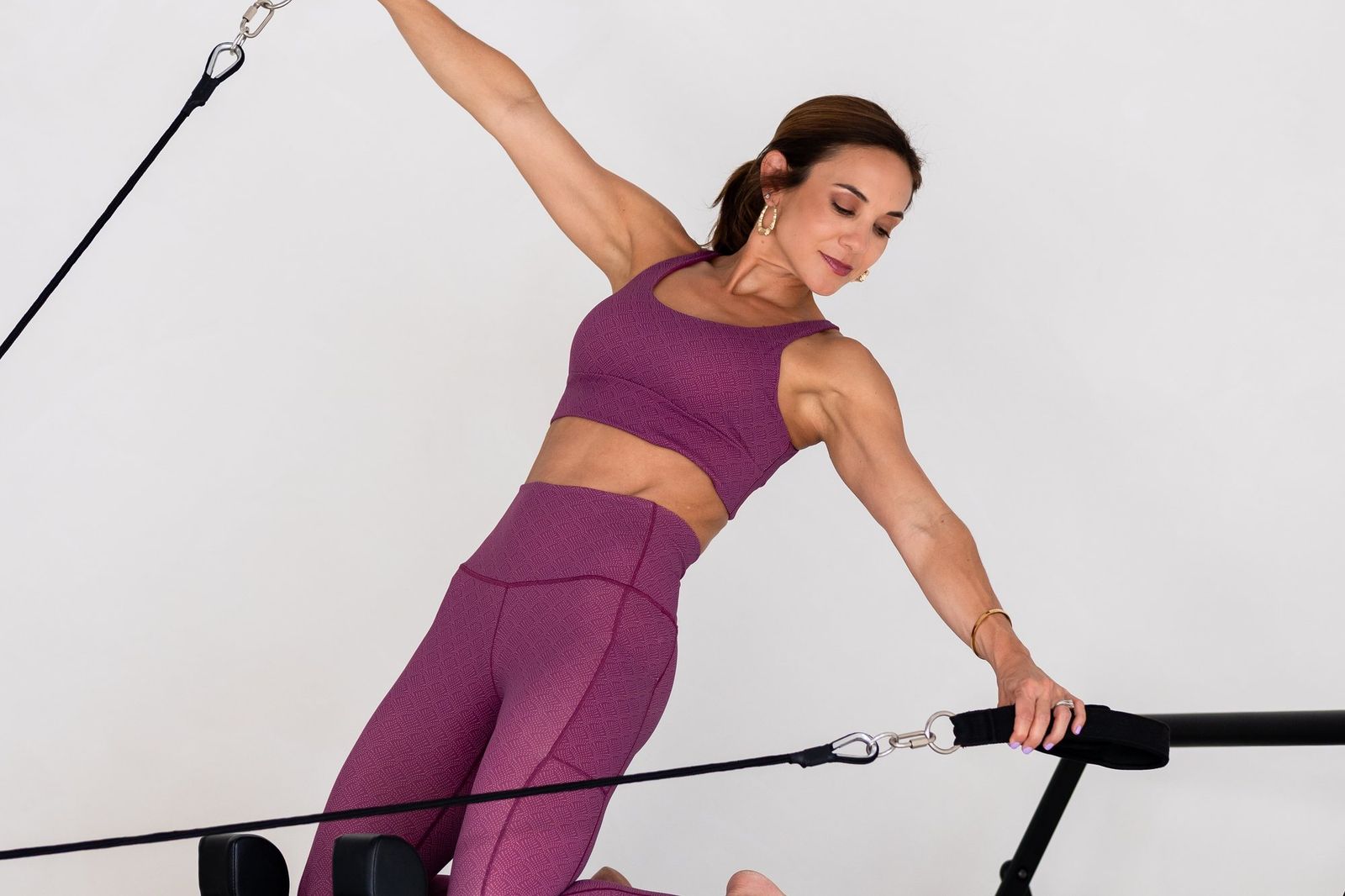
| Kneeling arm series, Reformer | Kneel facing the straps, one handle in each hand. Lift the straps up toward the ceiling. Exhale to reach, inhale to lower. Hips stay still over your knees. Option: one arm at a time. |
| Bridge, mat | Feet hip-width, arms by your sides. Press the floor away through your heels and peel up one bone at a time. Exhale to lift, inhale at the top. Want more? Float one foot. |
| Side-lying leg series with a ball | Lie on your side, ball under your top hand for balance. Lift the top leg toward the wall in front of you. Waist stays long off the mat. Option: bend the bottom knee for support. |
Notice how many of these cues point at something outside the body: the floor, the wall, the bar. Motor learning research supports this. A 2021 set of meta-analyses in Psychological Bulletin by Chua, Wulf and colleagues found that an external focus of attention (on the effect of a movement) led to better performance and learning than an internal focus (on the body parts doing it), across ages and skill levels. In Pilates, you still need body-based cues for alignment, so pair the two: one external image for the action, one internal check for what stays still.
Four types of cues
- Verbal. Your main tool. Short, specific, in the same order every time.
- Visual or demo. Show the shape briefly from the floor or beside the equipment, then get back to watching your class. You teach from where you can see everyone, not from a machine.
- Imagery. "Zip up a pair of tight jeans" or "grow taller through the crown of your head." One good image can replace three anatomy cues.
- Tactile, with consent. A light touch can help, but many instructors now avoid hands-on cueing or always ask first. If you use it, ask every time, keep it brief, and offer a verbal alternative.
Timing: cue ahead, say less, repeat what matters
Give the cue just before the movement, not halfway through it. People need a beat to process. Then cut your words. "Press out, control in" beats a full sentence on rep six. Pick one or two key cues per exercise and repeat them as the set goes on, rather than adding something new on every rep.
Music helps here. Let the beat carry the tempo so your voice can focus on form. Lift your energy for the series, soften it for the cool down.
Positive, specific language
Tell people what to do, not what to avoid. "Lengthen your neck" works better than "don't crunch your neck." Swap vague cues for specific ones. "Engage your core" means something different to everyone. "Draw your lower ribs toward your hips" gives people something to actually do.
Cueing several levels in one class
Teach the middle version first, then offer options in both directions: "Need less? Want more?" Frame them as choices, not rankings, so no one feels singled out for taking the easier version. Props are useful here. A ball, ring or band can make an exercise easier or harder, and it keeps the class playful.
Checking in and making people feel seen
Use names when you can. Give specific praise: "Beautiful control on the return, Jess" lands better than "good job." Ask quick questions: "Feeling that in your hamstrings?" At the end, thank people for coming. These small moments are often what people remember on the drive home.
Common mistakes to avoid
- Over-cueing. A constant stream of words becomes background noise. Leave space.
- Anatomy lectures. Your class came to move, not to study. Save the detail for a workshop.
- Cueing only yourself. If you're doing the whole class with them, you are not watching them. Demo, then observe and correct.
- Vague core cues. Replace "engage your core" with one concrete action.
Build your classes with Instructor Academy
If you want support turning great cueing into great classes, the Pilates Project Instructor Academy is built for you. It includes class plans, a Flow Library, exercise tutorials and business-building tips from Maghan, who has been teaching Pilates since 2010. Doors open November 22, 2026, with presale starting November 19. Join the presale list for Founding Instructor pricing and first access: Join the presale list.
Questions
How many cues should I give per exercise?
Start with setup, one action cue and the breath. Add a focus cue and options once the class has the basic movement. One or two repeated key cues usually beat a long list.
Should I use hands-on cues?
Only with clear consent, every time. Many instructors avoid touch entirely and rely on verbal, visual and imagery cues, which work well on their own.
What is an external focus cue?
A cue that directs attention to the effect of the movement or something outside the body, like "press the bar away" or "reach toward the wall." Research suggests these often help people move and learn better than cues about specific muscles.