Pilates Ball Exercises for a Stronger Core
A soft Pilates ball is small, cheap to store and surprisingly hard to ignore. Here is how to use it to make your mat work smarter, plus a short sequence you can do today.
Why add a small ball to your mat work?
You can do plenty of Pilates with nothing but a mat. A small ball just makes your work easier to feel. Here is what it adds:
- Feedback. Squeezing the ball tells you right away if you have let go. If the ball slips, your focus slipped too.
- Inner thigh work. A gentle squeeze between the knees or ankles brings in your adductors, the inner thigh muscles that help steady your pelvis.
- Support or challenge. Tucked behind your back or head, the ball supports you. Held in your hands or passed from hand to hand, it asks more of your core and balance.
That fits how we teach at Pilates Project: props and small apparatus keep classes fun, and every exercise has a way to make it easier and a way to make it harder.
Before you start. Move slowly, breathe and stay in a range that feels good. Stop if anything hurts. If you are pregnant, postpartum, have back pain or think you may have diastasis recti (a separation of the abdominal muscles), check with your doctor or a physical therapist first, especially before chest lifts, criss-cross and the V-sit.
The exercises
1. Pelvic curl with ball squeeze
Works: glutes, hamstrings, inner thighs and deep abdominals.
- Lie on your back, knees bent, feet hip-width apart, ball between your knees.
- Inhale in a neutral spine and gently squeeze the ball.
- Exhale and curl your tailbone up, lifting one bone at a time to a bridge.
- Inhale at the top, then exhale and roll down slowly.
Easier: Lift only halfway. Harder: Hold at the top and pulse the squeeze 5 times. Reps: 8–10.
2. Chest lift with ball
Works: front abdominals (rectus abdominis) and deep core.
- Lie on your back, knees bent, ball between your knees, hands behind your head.
- Inhale to prepare, keeping your pelvis neutral.
- Exhale, squeeze the ball and curl your head and shoulders up.
- Inhale to hold, exhale to lower with control.
Easier: Rest your head on the ball and lift only your shoulders a little. Harder: Hold the lift for 3 breaths. Reps: 8–10.
3. Roll-back with ball support
Works: abdominals, spinal control.
- Sit tall with knees bent, feet flat, ball behind your lower back.
- Reach your arms forward and inhale.
- Exhale and roll back into the ball, scooping your belly.
- Inhale to pause, exhale to roll back up to sitting.
Easier: Let a little more air out of the ball. Harder: Slowly twist to one side while you are rolled back. Reps: 6–8.
4. Single leg stretch with ball pass
Works: abdominals, coordination, hip flexor control.
- Lie on your back, head and shoulders lifted, ball in both hands.
- Draw your right knee in and pass the ball under it from hand to hand.
- Switch legs and pass the ball under the left knee.
- Exhale with each pass and keep your lower back steady.
Easier: Keep your head down and your legs higher. Harder: Lower the straight leg toward the mat. Reps: 10 passes.
5. Criss-cross with ball
Works: obliques and deep abdominals.
- Lie on your back with knees in tabletop, ball between your knees.
- Lift your head and shoulders, hands behind your head.
- Exhale and rotate toward the right, extending the left leg if you can.
- Inhale through center and switch sides.
Easier: Keep both feet on the mat and just rotate. Harder: Move slower and hold each twist for a breath. Reps: 8 per side.
6. Side-lying leg lift with ball
Works: inner and outer thighs, side body, balance.
- Lie on your side, legs long, ball between your ankles.
- Stack your hips and lightly lift your waist off the mat.
- Exhale and lift both legs together, squeezing the ball.
- Inhale and lower with control.
Easier: Bend your knees and hold the ball between them. Harder: Lift your top arm or come up onto your forearm. Reps: 8–10 per side.
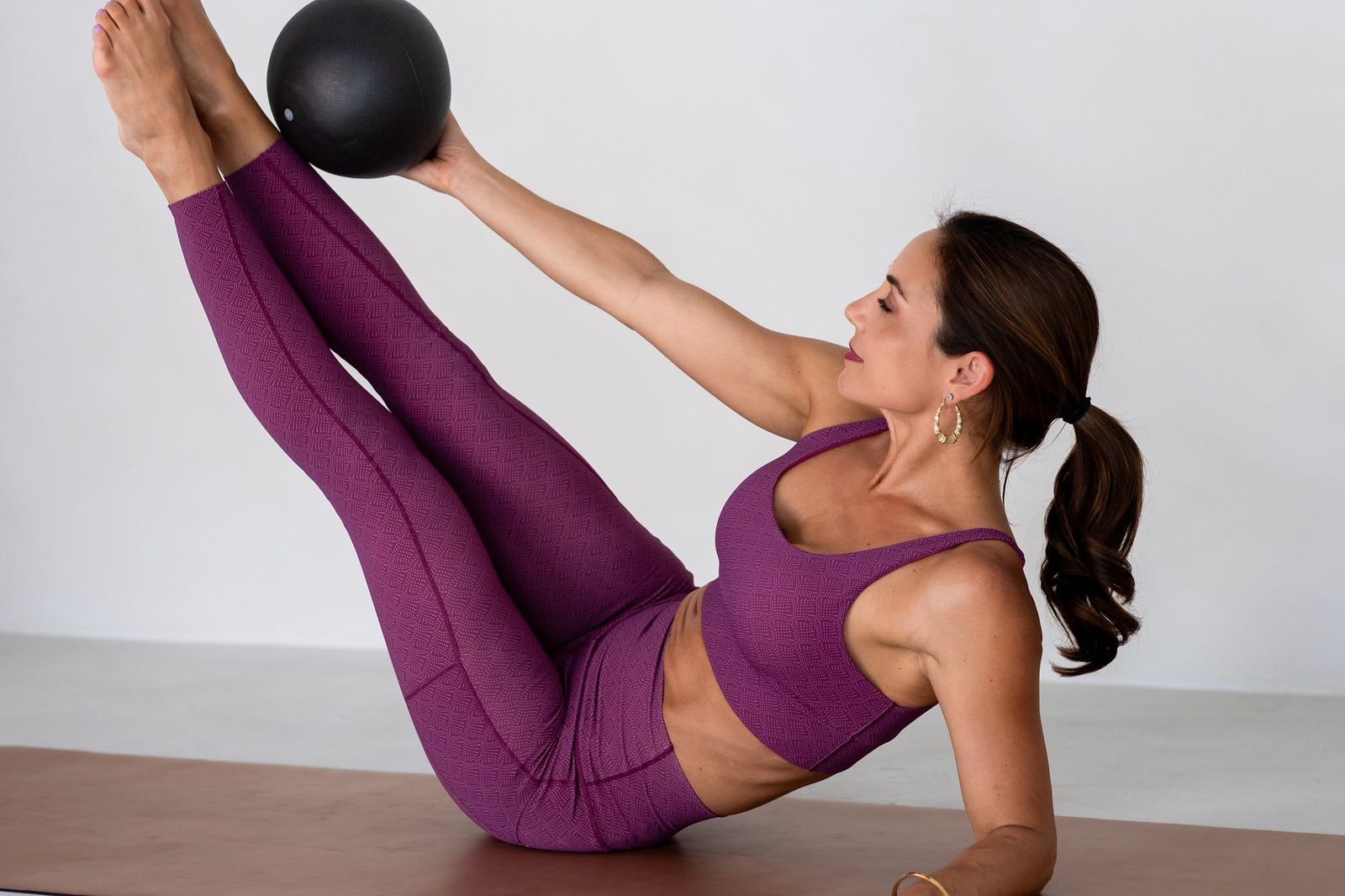
7. V-sit (teaser prep) with ball
Works: the whole core, hip flexors and balance.
- Sit with knees bent, holding the ball in your hands.
- Lean back slightly and lift your feet, shins parallel to the floor.
- Reach the ball forward and breathe, keeping your chest open.
- For more, place the ball between your feet and reach your hands toward it.
Easier: Keep your toes on the mat. Harder: Straighten your legs toward a full teaser. Reps: Hold 3–5 breaths, 3 times.
A 10-minute ball sequence
Run through this once or twice, moving with your breath:
- Pelvic curl, 10 reps
- Chest lift, 10 reps
- Roll-back, 8 reps
- Single leg stretch with ball pass, 10 passes
- Criss-cross, 8 per side
- Side-lying leg lift, 10 per side
- V-sit, 3 holds
Do it two or three times a week alongside your regular training. Consistency counts more than intensity.
What the research says
Pilates has been studied most for low back pain. A Cochrane review found low to moderate quality evidence that Pilates probably helps pain and disability more than minimal intervention in the short term, but no clear sign it beats other exercise. A summary in American Family Physician reached a similar view and noted that side effects were uncommon and mild. In short: Pilates is a safe, useful way to train your core, and the best routine is one you will keep doing.
Ready for more? Join the Pilates X Strength 21-Day Challenge, starting Monday, November 30, 2026.
Questions
What size Pilates ball should I use?
A soft, small ball about 9 inches across, slightly underinflated so you can squeeze it, works well for these exercises.
Can I do these if I do not have a ball?
Yes. A small, firm pillow or a rolled towel works for the squeeze and support exercises. You can also do them with no prop at all.
Will Pilates ball exercises flatten my stomach?
No exercise can burn fat from one spot. What these moves can do is build strength, control and endurance in your core, which helps you move and feel better.